Flavoured tea – from Earl Grey to traditional flavouring
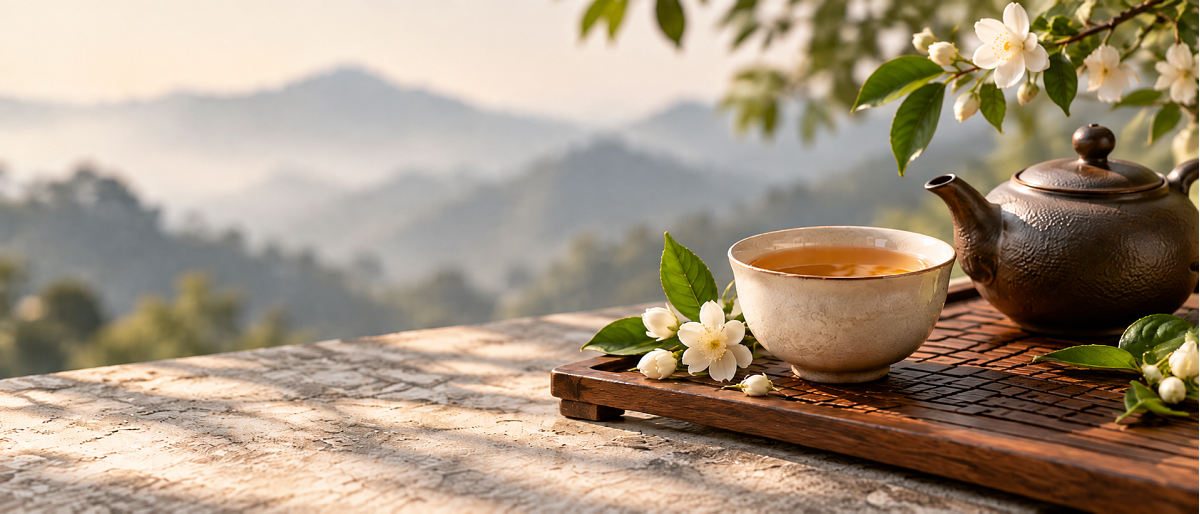
For many people, flavoured tea is the first step into the world of tea. Earl Grey, jasmine tea, chai and teas flavoured with fruit, flowers or spices are among the best-known examples. But the term flavoured tea covers far more than the aromatic blends found on almost every tea shelf today.
Adding another aroma or flavour to tea is by no means a modern invention. Across different tea cultures, tea has long been combined with flowers, spices, citrus, smoke and other ingredients. Some of these methods are highly labour-intensive and have developed into traditions in their own right.
There can therefore be a considerable difference between one flavoured tea and another. At one end are teas to which a flavouring is added after the tea has been produced. At the other are teas where flavouring forms part of a traditional production method, with the character of the tea itself and the added flavour intended to become a coherent whole.
What is flavoured tea?
At its simplest, flavoured tea is tea that has been given an additional flavour or aroma.
This can be done in many different ways. Tea may be blended with spices, fruit peel or flowers. It can be scented through contact with fresh flowers, flavoured with citrus oil or other flavourings, or acquire its character through methods such as smoking.
The base can be black, green, white or oolong tea. The tea you start with makes a significant difference. A robust black tea can carry pronounced spices and citrus, while a lighter green tea can be paired with jasmine without completely losing the character of the tea itself.
This is also why two teas both described as, for example, jasmine tea or Earl Grey can taste very different.
Flavoured tea has a long history
People have been combining tea with other flavours for a long time. As tea spread between regions and cultures, different ways developed of adapting the drink to local ingredients and preferences.
In China, among other traditions, the art of scenting tea with flowers developed. Jasmine tea is the best-known example, although osmanthus and rose have also been used.
Elsewhere, spices became important. In India, different forms of spiced tea developed and eventually became associated with masala chai.
In Europe, another flavoured tea became something of an institution: Earl Grey.
Earl Grey – black tea and bergamot
Earl Grey is today one of the world's best-known flavoured teas. The classic combination consists of black tea and bergamot, an aromatic citrus fruit whose peel contains a highly distinctive oil.
The tea takes its name from Charles Grey, the 2nd Earl Grey, who served as British Prime Minister between 1830 and 1834. Exactly how the blend originated, however, is not entirely clear.
There are several stories about Grey having received a flavoured tea or a recipe from China. These stories exist in different versions and are better regarded as part of the history and mythology surrounding Earl Grey than as firmly established historical events.
During the nineteenth century, the combination of black tea and bergamot became established in Britain and has since spread throughout the world.
Today, Earl Grey can be made in many different ways. The base may be a robust black tea, a lighter Chinese black tea or a blend of teas from several origins. The bergamot character may come from bergamot oil, flavouring or a combination of different ingredients.
As a result, the name Earl Grey alone tells us relatively little about how the tea will actually taste. The balance between the base tea and the bergamot is crucial.
In a well-balanced Earl Grey, the citrus character is clearly present, while the tea beneath it retains a character of its own.
Bergamot meets Taiwanese oolong
Bergamot does not have to be limited to the classic combination with black tea. One of our own examples is Bergamot Oolong 100 gram, where the base is instead a quality Taiwanese oolong tea.
The tea is flavoured with small pieces of bergamot, giving it a fresh and aromatic citrus note. What makes it particularly interesting is the way this meets the oolong itself: its soft, full-bodied character remains present in the cup, while the bergamot complements it without taking over.
The result is a softer and more nuanced interpretation of the familiar combination of tea and bergamot. It is not simply Earl Grey in another form, but a flavoured tea in its own right, where the quality of the base tea is at least as important as the flavouring.
For anyone who knows bergamot mainly through Earl Grey, it is also an interesting way to discover how the same citrus character changes when paired with an entirely different type of tea.
Jasmine tea – when flowers scent the tea
Jasmine tea shows a very different side of tea flavouring.
Traditional jasmine tea is not made simply by mixing flowers into finished tea. Instead, the tea is brought into contact with fresh jasmine flowers as they open and release their fragrance.
The tea absorbs the aromatic compounds from the flowers, after which the flowers are separated from the tea. For finer grades, the process may be repeated several times using new batches of fresh flowers.
It is a labour-intensive process, but the result can be quite different from a tea to which a ready-made jasmine flavouring has simply been added.
A good traditional jasmine tea does not have to be overwhelmingly perfumed. Instead, the jasmine can become intertwined with the tea's own fresh, sweet or slightly astringent character.
It is a good example of why the strongest aroma does not necessarily mean the most flavour.
When we drink tea, we experience taste and aroma together. A tea can smell wonderful when the packet is opened, yet seem relatively simple once brewed. Another may be less explosive in aroma but reveal considerably more in the cup itself.
For us, the latter is often more interesting.
Spices, flowers and other traditional flavourings
Jasmine and bergamot are only two examples.
Spiced tea has long traditions, particularly in South Asia. Combinations including cardamom, ginger, cinnamon, cloves and pepper can produce powerful flavour experiences, with the tea often brewed together with milk and sweetening.
Flowers have been used in different ways in China and other parts of Asia. Osmanthus, for example, gives a soft, sweet and fruity floral character and can be combined with oolong among other teas.
Smoke can also be regarded as a way of influencing the character of a tea. Smoked black tea is particularly associated with Lapsang Souchong, whose distinctive smokiness sets it apart from most other black teas.
What these methods have in common is that the flavouring does not need to conceal the tea. When the combination works well, it can instead add another dimension to a good base tea.
Modern flavoured teas
Most of today's flavoured teas are not produced using time-consuming traditional scenting methods. Modern flavourings make it possible to create an enormous variety of flavour profiles, ranging from peach, vanilla and mango to caramel, champagne and strawberry.
Flavoured teas can be both full of character and highly enjoyable. The result depends on the quality of the base tea, the character of the flavouring and, above all, how well the two work together.
There is also considerable variation between different flavoured teas. In some, the added flavouring is very much at the centre of the experience, while others allow the tea's own character to play a greater role. We find the latter particularly interesting, as the interaction between the tea and the flavouring often gives you more to discover in the cup.
This is why we also like to highlight more traditional ways of flavouring tea. A fine jasmine tea, a well-balanced Earl Grey or a spiced tea can show how the added flavour does not have to sit separately from the tea, but can instead become part of the overall taste experience.
Explore the flavouring – but don't forget the tea
For those accustomed to fruity and aromatic tea blends, traditionally flavoured teas can be an interesting next step.
A genuine jasmine tea, for example, does not necessarily taste like jasmine flavouring. An Earl Grey can offer more than bergamot alone. A spiced tea can change completely depending on the black tea beneath the spices.
This is when flavoured tea becomes particularly interesting: when you can experience both the tea and what has been added to it.
There is therefore no simple dividing line between “real tea” and flavoured tea. Some of the world's most classic teas are built precisely on the meeting between the tea leaf and another aroma or flavour.
For anyone wishing to explore flavoured tea, we therefore recommend looking beyond whichever flavour sounds most appealing. Try teas that have been flavoured in different ways and notice how much of the tea's own character remains in the cup.
It can be the path from an enjoyable flavoured tea into an entirely new part of the world of tea.