Darjeeling Tea
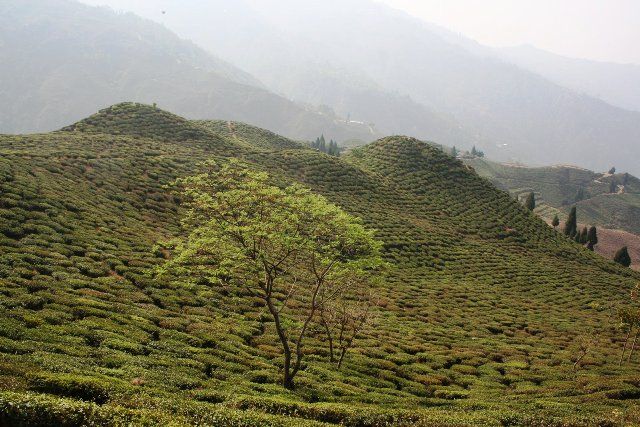
DARJEELING – TEA FROM THE HIMALAYAN SLOPES
Darjeeling is tea grown in the classic tea gardens of the Darjeeling district in northern West Bengal, India. The region lies on the southern slopes of the Himalayas and borders Nepal, Sikkim and Bhutan. The tea gardens are located at altitudes from about 750 up to just over 2,000 metres above sea level, with cool nights, abundant rainfall and mist that give slow growth and concentrated flavour.
To be called genuine Darjeeling tea, the tea must come from the geographically defined area and be approved by the Tea Board of India. There are around eighty classic tea gardens (Tea Estates) in Darjeeling, and a relatively limited cultivated area compared to many other tea regions in India.
Darjeeling production makes up only a small share of India’s total tea output – often around one percent by volume. At the same time, much more tea is sold globally under the name "Darjeeling" than is actually produced in the region. This means that many cheap Darjeeling teas on the market are in practice blends where only a small part is genuine Darjeeling.
DARJEELING – BRIEF HISTORY
The Darjeeling area became interesting to the British during the 19th century, both as a healthy hill station in a cooler climate and as a potential location for tea cultivation outside China, at the foothills of the Himalayas.
The first attempts to grow tea in Darjeeling were made in the 1840s by Dr. Campbell on his Beechwood estate, using seeds brought from China. The first commercial tea gardens were established by the British around the 1850s, among them Tukvar, Steinthal and Aloobari.
The number of estates then grew quickly, and Darjeeling gradually established itself as a style of its own: a light, aromatic tea with clear fruitiness and a character often described as "muscatel".
TEA BUSHES AND STYLE – WHY DARJEELING TASTES DIFFERENT
In Darjeeling, growers mainly use the Chinese variety Camellia sinensis var. sinensis, which originally comes from China. It copes better with higher altitudes than the broader-leaf Assam variety, but yields fewer leaves and lower volume.
On the estates you find both plantings grown from seed and more modern clonal plantings. Some older sections still consist of bushes that descend from the first plantings in the 19th century.
Although Darjeeling is usually classified as black tea, many of the teas are considerably lighter and greener in leaf colour than classic black teas from other parts of India. Green, white and oolong teas are also produced in Darjeeling, but in smaller volumes.
HARVEST SEASONS – FLUSHES
First Flush – spring harvest

First Flush is the year’s first harvest and takes place from around mid-March, depending on the weather, when the plants have awakened from winter dormancy. The new shoots grow slowly and produce teas with light green leaves and a light, fresh cup with floral and often slightly sweet notes.
Technically, many First Flush teas are made with a lower degree of oxidation than classic black teas, and in some respects the processing resembles a lightly oxidised oolong. This is an important reason why the leaves often look greener and the flavour is perceived as fresher and more "spring-green" than in other black teas. These teas are highly sought after among Darjeeling enthusiasts.
Second Flush – summer harvest

Second Flush is usually harvested in May–June, before the monsoon rains. The teas become darker in appearance and brew a deeper, amber-coloured liquor. This is where the classic "muscatel" note often appears – a grape-like, fruity character that many associate specifically with Darjeeling.
Monsoon Flush
During the monsoon period the tea plants grow quickly and the leaves become large and coarser. Tea from this period generally has lower aromatic complexity and is often used for simpler blends. Monsoon Flush is rarely what Darjeeling is known for in terms of quality.
Autumnal Flush – autumn harvest
After the monsoon, in October–November, the Autumnal Flush is harvested. The leaves are larger and the teas give a rounder, fuller cup with less green freshness but a softer, more mature character. Autumn teas can be a good-value option for those who want Darjeeling with more body and less spring-like greenness.
AUTHENTIC DARJEELING AND QUALITY
Because Darjeeling produces relatively small volumes while demand is high, counterfeits have long been a problem. Cheaper teas may be sold as "Darjeeling" even though they only contain a small proportion of genuine Darjeeling or none at all.
Authentic Darjeeling is controlled through a geographical indication (GI) and a special seal from the Tea Board of India. For the consumer, origin, estate, harvest (flush) and the reliability of the seller are important clues to quality.
GRADES OF DARJEELING TEA
Darjeeling tea is graded according to leaf size and appearance, not directly by flavour. Higher grades often mean more carefully plucked leaves, but are not in themselves a guarantee of quality. We generally focus on whole leaf and higher grades from selected estates.
Dust and fannings – for teabags and simpler tea
D (Dust) – very finely broken tea, mainly used in teabags.
Fannings – small leaf particles, smaller than broken leaf.
Broken leaf – broken leaves
FBOP, TGBOP and others – broken leaves with some tips; give stronger tea and faster extraction.
Whole leaf – higher leaf grades
FOP, TGFOP, FTGFOP, SFTGFOP – whole leaves with varying amounts of tips. The more "tippy" designations, the more focus on fine buds and visually high leaf standard.
However, the grade does not tell the whole story – year, estate, harvest and handling are at least as important for the final cup.
TEA ESTATES IN DARJEELING
Darjeeling consists of a number of well-known tea estates with their own styles. Here are a few examples you often see in our selection:
Castleton Tea Estate
Location: southern Kurseong sub-district
Altitude: about 915–1,830 metres
Founded in the 1880s. Known for elegant First and Second Flush teas with clear aroma and muscatel notes.
Jungpana
Location: southern Kurseong
Altitude: about 900–1,400 metres
Known for high-quality teas, often based on China bushes.
Produces teas with depth, complexity and a long aftertaste.
Sungma
Location: western Darjeeling district
Altitude: about 1,100–1,700 metres
Produces both classic First Flush and Second Flush teas, often with a focus on China bushes and some clonal sections.
Thurbo
Location: Mirik area
Altitude: about 700–1,900 metres
Known for extensive use of clones and for producing teas with clear, clean aroma and good strength.
See our wide selection of Darjeeling teas:
Darjeeling tea selection »