Wu Yi
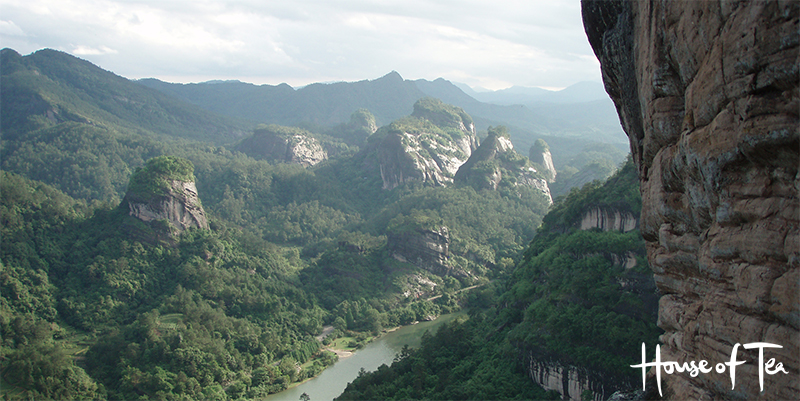
WU YI – CHINESE ROCK OOLONGS FROM FUJIAN
Wu Yi Shan is located in northern Fujian province in China and is one of the country’s most famous tea-growing regions. This is where the classic rock oolongs – Yan Cha – are produced: oolong teas that grow in a mineral-rich mountain landscape and are roasted over charcoal. Teas from Wu Yi are known for their complex flavour, clear minerality and the special taste and aftertaste that in Chinese is called yan yun – often described as a mineral-rich “rock character”.
The area has played an important role in China’s tea history. Both early oolong teas and some of the world’s first black teas were developed here. Today, Wu Yi Shan is one of the most respected tea regions in China.
HISTORY – FROM TEA CAKES TO ROCK TEA
Already during the Tang dynasty (618–907) and into the Song dynasty (960–1279), tea was produced in the form of pressed cakes in Wu Yi. These cakes were used as tribute tea for the emperor – tea of the highest quality that was sent to the imperial court. Tea also functioned as a kind of currency, which made tea cakes economically important.
During the Ming dynasty this changed when Emperor Zhu Yuanzhang banned the production of tea cakes to counter corruption. Equipment was confiscated and tea production in the area decreased sharply. Monks in the monasteries around Wu Yi, however, continued to cultivate and process tea on a smaller scale.
Gradually, production shifted over to loose-leaf tea. It was also here that a new method was developed: tea that is partially oxidised and then roasted over charcoal – the beginning of oolong from Wu Yi Shan, tea that is still roasted by hand in several stages today.
TEAS FROM WU YI SHAN
The Wu Yi area produces many famous oolong teas. Several of them are counted among China’s most highly regarded teas.
DA HONG PAO
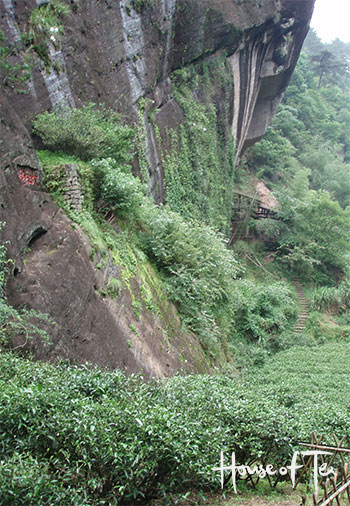
Da Hong Pao is one of China’s most legendary teas and is often called “the king of rock teas”. Only six original bushes remain, growing on a rock ledge above the famous Nine Bend River. The tea sold today as Da Hong Pao comes from clones and later generations of these bushes.
Tea from the original bushes is reserved for the Chinese state, and small amounts that have previously been auctioned have sold for extremely high prices. This has contributed to Da Hong Pao’s status as one of the world’s most mythical teas.
Traditionally Da Hong Pao is roasted slowly over charcoal, for up to around 24 hours. This gives a deep, roasted and complex flavour profile. In more modern production there are also lighter and shorter roastings, which give a softer and less heavily roasted style. With traditional heavy roasting the tea needs time to mature so that the roasted notes can settle and a better balance can develop.
SHUI XIAN (SHUI HSIEN)
Shui Xian is one of the classic cultivars from Wu Yi, known for its large leaves and full-bodied flavour. The name is often translated as “water fairy” or “water spirit”.
Traditionally Shui Xian is roasted for a longer time, which gives a powerful, aromatic tea. There are many simpler versions on the market, and much of what is sold as Shui Xian comes from other parts of Fujian, not only from Wu Yi. The cultivar, however, is strongly associated with Wu Yi rock tea.
ZHENG SHAN XIAO ZHONG (LAPSANG SOUCHONG)
Black tea (hong cha) is generally considered to have its origin in the Wuyi mountains, when what we now call Zheng Shan Xiao Zhong was developed in the Tongmu area during the late Ming dynasty. In tea history, Zheng Shan Xiao Zhong is often regarded as the first black tea, or at least the earliest known black tea that became widely recognised. This tea is the original behind the name Lapsang Souchong, even though many modern versions differ greatly from the original style.
Traditionally the leaves are allowed to wither and oxidise, and are then dried and roasted. In the classic smoked style, the tea is dried over fires of pine wood, which gives a smoky, woody character. Many cheaper versions on the market, however, are flavoured with smoke aroma instead of being dried over real wood fires.
TIE LUO HAN
Tie Luo Han is another famous rock tea from Wu Yi. The name means roughly “Iron Arhat” – a reference to a powerful, enlightened monk figure in Buddhist tradition. The tea is often deeply roasted and can give associations to cocoa, dark roast and mineral-rich depth.
QI LAN
Qi Lan is an aromatic and popular Wu Yi tea. The degree of roasting can vary, but the tea is often clearly floral and mineral-driven. It is a good example of how Wu Yi tea can combine both aroma and depth in the flavour.
BAI JI GUAN
Bai Ji Guan is one of the classic cultivars from Wu Yi and stands out clearly from many other rock teas. The leaves often have a lighter, yellow-green tone and the flavour is milder and lighter, but still with the typical rock character from the area.
PRODUCTION OF WU YI OOLONG TEA
Unlike many green teas, older tea bushes or small tea trees are often used in Wu Yi. The goal is to have deeper-rooted plants and more concentrated flavour.
Tea picking only takes place under the right conditions: no rain, no dew on the leaves and not too strong sun. Harvesting takes place from the end of April to mid-May, later than for many other teas, in order to pick more developed, aromatic leaves.
The production of Wu Yi oolong follows several steps:
- Withering: the leaves are allowed to dry slightly, often in the sun, to reduce moisture.
- Oxidation: the leaves are shaken and aired in baskets so that the edges bruise and controlled oxidation can take place.
- Fixing / first roasting: the leaves are heated to stop oxidation at the desired level.
- Rolling: the tea is rolled to shape the leaves and distribute juices and aroma compounds.
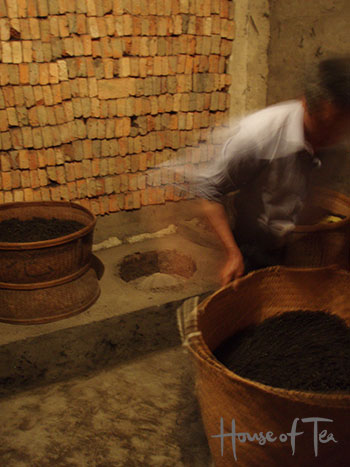
- Charcoal roasting: final baking over charcoal in baskets, often in several stages over many hours or longer periods.
Roasting is crucial for the final result. A skilful roast can bring out minerality, sweetness and depth, while an unbalanced roast can give burnt or flat notes.
AGING WU YI TEA
Wu Yi tea is suitable for ageing if it has been traditionally and thoroughly roasted. A higher roast makes the tea more stable over time. Freshly roasted tea can feel very strong and heavily roasted right after production and is therefore often drunk only after it has been allowed to rest for several months.
Some producers age their rock teas for longer periods and re-roast them about every three years to extend the storage time and adjust the flavour. Well-made Wu Yi teas can gain in smoothness, depth and balance over time.
If you wish to age Wu Yi tea yourself for a longer period, a ceramic container is a classic option:
- Unglazed ceramic: lets more air through, gives faster development and a somewhat higher degree of oxidation.
- Glazed ceramic: more protected environment, slower development.
Tea that is not traditionally roasted – for example very lightly roasted, greener oolong – is less suitable for long ageing and should be better protected from air and moisture.
WU YI SHAN – MOUNTAIN AREA AND NATIONAL PARK
Wu Yi Shan is both a tea region and a national park with great cultural and historical significance. Traces of human activity in the area go far back in time, and the mountains have played an important role for Daoism, Buddhism and later also Neo-Confucianism.
The area is today listed as a UNESCO World Heritage site, both for its nature and its cultural history. Wu Yi has high humidity, abundant rainfall and a subtropical climate that is very well suited to tea cultivation. The mountains are made up of volcanic and plutonic rock, and the soil is mineral-rich – something that is often highlighted as part of the distinctive character of rock teas.
Tea cultivation takes place both inside and around the park, but the core areas are protected. Tea growers live outside the core of the park and are allowed to enter to tend their tea fields. Along paths and cliffs you can see tea bushes and small terraces in many places throughout the area.
WU YI TEA AND HEALTH
Wu Yi oolong has at times been heavily marketed as a “weight loss tea” with big promises about slimming effects. Such marketing often relies on low-quality teas and oversimplified interpretations of research.
There are studies that have examined tea, including oolong, in relation to fat burning and energy metabolism. Some have shown a modest increase in energy expenditure after tea consumption, but the results vary and are not evidence of miracle effects. Wu Yi tea can be part of an otherwise balanced lifestyle – not a shortcut to weight loss.
We focus on Wu Yi teas with clear origin, high quality and flavours that are worth drinking for their own sake. If you want to read more about research on tea and metabolism, you can follow the studies we link to below.
USDA – research on tea and fat metabolism
“Oolong tea increases energy metabolism” – Japanese study